Friday, September 26, 2008

Beware of Exotic Species

Do you have a parrot in your home? How about some sort of tropical plant, or a flower not native to the area? If you do, please keep track of them!

Introduced species are one of the main reasons for decreasing biodiversity. When organisms that are not native to an area are let out into the environment, they have no natural predators and may quickly spread. Of course, not all species can be established in an area. On average, out of every 10 introduced species, 1 will become established. Out of 10 established species, 1 will become a "pest." This is known as the Tens Rule.

These "pests" can out-compete native animals and plants, and completely change the structure of an ecosystem. Examples of introduced species include the African Honey Bee, which preys on North American bees and has really destroyed a great part of the honey-making industry, and Kudzu, which has really taken over a lot of plant communities. Zebra Mussels too, have threatened the biodiversity in the Great Lakes.

So, don't just let your pets or plants out into the wild if you don't feel like keeping them any more! You never know what may happen.

This image is from The Hedonistic Imperative.

Sunday, September 21, 2008

Visit Throwplace.com

Do you have lots of old items that could be useful to someone else? I know I do- pieces of furniture that don't match, electronic equipment I don't want, outgrown clothing- but sometimes it's too much work to have a yard sale that probably won't make too much money anyways. Besides, my goal isn't to make money, just to get rid of some stuff.
I could donate to the Salvation Army, but I never know when their pick-up times are, and the Goodwill is too far for me to lug my stuff to. I could recycle, but as I went over in this post, it isn't always the best thing to do.

Well, put Throwplace.com into the picture! Your junk could really become someone's treasure (and vice versa). Here's a website that let's you post up items you don't want, so other individuals/businesses/charities can pick them up.

There's a section to "throw into" - where you list items you have and don't want, and a section to "take from" - where you can look for something you might need. You never know what you may find, and it's good to know that your unneeded possessions are put to good use by someone who does need them.

This unique website allows items to be continually reused, which reduces cost and consumption, qualities we all need right now.

Saturday, September 20, 2008

Sad but True

As I was working today, I saw this bumper sticker on a car.

"At least we are winning the war on the environment."


It made me sad :(

Wednesday, September 17, 2008

Dispose of Medicine Properly

Apparently, some people flush their leftover prescriptions down the toilet. I was totally not aware of this until I saw the recent news article stating that low levels of prescription medicines were tested in our water supply!

There were all sorts of chemicals found in the water, including low doses of hormones and mood-stabilizers. The doses were said to be too low to cause any effects, but who knows what can happen if we keep tossing our drugs down into the water?

The U.S. water treatment system is very extensive. From our drains and the storm water drains the dirty water flows into primary treatment. Primary treatment is mostly designed to remove the "nasty" stuff from our water- for example, big pieces of debris and waste, dead animals, etc. Then water is put into a tank where all the dirt and particulate matter settles down to the bottom and becomes sludge, which either goes to a landfill or is used in agriculture. The water goes through other steps, including aeration by bacteria and chlorination.

Some places have secondary treatment, where the water goes through more specialized treatment. Then the water is let out into a body of water or reservoir.

Well, there is no step that removes all of these drugs from the water! I know it is in low doses, especially dissolved in all of that water, but the one thing we should have learned is that it is best not to test the environment. Bad effects may not happen until further down the road. Who knows what these man-made chemicals can do to ecosystems?

This is an easy problem to ease. Just properly dispose of all your medicines (but I heard that you absolutely should use the entire prescription on certain substances like antibiotics, depending on your doctor's orders.)

So, now I will open the floor to my readers (if I have any). What are your thoughts on this strange and unsettling phenomenon?

Saturday, September 13, 2008

Create a Compost Pile

Maybe I'm just a little strange, but sometimes I feel bad just throwing out fresh vegetable and fruit scraps into the garbage. I mean, that stuff is natural and decomposable! However, there is no way those bits will break down in a landfill, where it will be pressed down without oxygen and bacteria.

I could get a pig and feed it all my peelings and scraps...but I think I could run into some problems. An easier way to "recycle" your veggie bits and ends is to create a compost pile! If you have a garden, then the compost later can be used as organic fertilizer for your plants. I'm no authority on the ins and outs of composting, so I have compiled a list of sites I have found really helpful below.

How to Compost- this is a extremely comprehensive website for beginners and experts alike. There are lots of general tips, and also some specialized information. For those that love science, the site includes a section about the the scientific details, such as carbon-to-nitrogen ratios.

Tree Hugger
has a fairly basic but straightforward guide to composting.

An interesting site, Journey to Forever, that has articles on composting, as well as "humanure?" I'd say no to the latter part.

If you live an apartment, or have no backyard, visit Mahalo, for a guide on how to compost indoors (without the smell)!

More indoor composting at Tiny Choices.

As you can see, there are various ways to compost, suitable for every lifestyle. Don't limit yourself! This image is from Denver Recycles. It looks so earthy, doesn't it? I wish my soil looked like that.

Sunday, September 7, 2008

Save the Birds

Do you ever have birds crashing into your sliding glass doors or windows? If not, this post may be irrelevant to you, but if you do, keep reading for a fun way to help the birds and recycle at the same time!

According to the Audubon Society, millions of birds each year die from flying into glass surfaces. Some may only see the reflection of trees and grass, while others may not see the glass at all.

From the Journal of Field Ornithology in 1990, Daniel Klem estimated that glass kills 5% of the total number of birds living in the United States, more than pollution, poisons, and cars.

So, what can you do? Of course, you could rebuild your windows and make them smaller, but nobody would be willing to undertake that project, both for aesthetic reasons and cost. Fortunately, there are easier methods. Simply taking a piece of black construction paper, cutting it into the shape of a falcon, and hanging it somewhere on your glass/door should do the trick. Birds recognize the ominous shadow of the predator.

Another creative strategy comes from TimesRecordNews.com, the Scare Owl. This fun design of an owl's face recycles two old compact disks, used as the owl's eyes. The sunlight that reflects off the disks will warn birds of the glass surface. Click on the above link for more detailed instructions.

And if you've watched any funny home videos, you will know that this tip may save more than just birds from bumping to sliding glass doors...

This image is from Birding in British Columbia.

Thursday, September 4, 2008

Use a Real Lunch Bag/Box

Remember that unpopular kid in middle school who always lugged around a big, bulky lunchbox? Well, reusable lunchboxes and bags have since made a comeback!

Bringing lunches in small brown paper sacks and plastic bags may seem convenient and appealing, but those flimsy things can really do some damage to the environment! Think of all the trees and oil needed to create the materials in the first place, and then the fossil fuels used to manufacture the raw goods into the picture perfect squares. Then there's the fact that rarely do school cafeterias or workplace lunchrooms have recycling bins. Sadness.

Say you bring in a bag each day for lunch. That's obviously 365 bags a year, and 3650 bags for each decade. Over the course of your lifetime, you may discard over 300,000! Quite literally, a ton. Even paper, usually biodegradable, will probably not be able to decompose in a landfill environment, where it is compressed tightly and buried under all sorts of garbage.

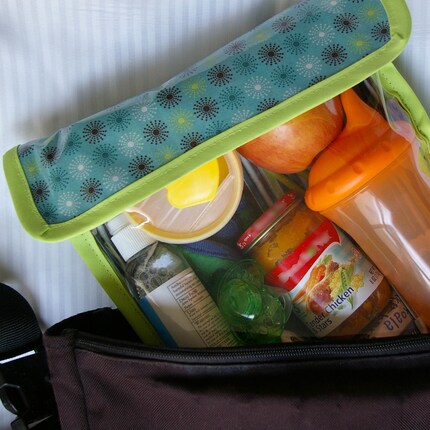
Luckily, there are many new and fashionable alternatives to the boring and destructive brown paper bag. Seriously, look at this adorable one from Green Home.
It's made out of certified organic cotton. Here's the Savvy Snack Bag from Etsy.

This Next also has a bunch of stylish designs, for adults and children alike.

Unbearably cute! I want one of those!

There are so many options to chose from. If you don't really fancy any of these examples, I am sure there will be one to your liking somewhere on the internet.