Showing posts with label vegetables. Show all posts

Saturday, November 8, 2008

Subscribe to a Local CSA


CSA stands for Community Supported Agriculture. According to the United States Department of Agriculture,
It is a community of individuals who pledge support to a farm operation so that the farmland becomes, either legally or spiritually, the community's farm, with the growers and consumers providing mutual support and sharing the risks and benefits of food production. Typically, members or "share-holders" of the farm or garden pledge in advance to cover the anticipated costs of the farm operation and farmer's salary. In return, they receive shares in the farm's bounty throughout the growing season, as well as satisfaction gained from reconnecting to the land and participating directly in food production. Members also share in the risks of farming, including poor harvests due to unfavorable weather or pests. By direct sales to community members, who have provided the farmer with working capital in advance, growers receive better prices for their crops, gain some financial security, and are relieved of much of the burden of marketing.
From Local Harvest:

Many farms offer produce subscriptions, where buyers receive a weekly or monthly basket of produce, flowers, fruits, eggs, milk, meats, or any sort of different farm products.

A CSA, (for Community Supported Agriculture) is a way for the food buying public to create a relationship with a farm and to receive a weekly basket of produce. By making a financial commitment to a farm, people become "members" (or "shareholders," or "subscribers") of the CSA. Most CSA farmers prefer that members pay for the season up-front, but some farmers will accept weekly or monthly payments. Some CSAs also require that members work a small number of hours on the farm during the growing season.

A CSA season typically runs from late spring through early fall. The number of CSAs in the United States was estimated at 50 in 1990, and has since grown to over 2000

This is great for the environment because it supports local farmers and allows you to eat local, seasonal foods. By purchasing your groceries from a CSA instead of a huge corporation, you are decreasing the amount of pesticides, fertilizer, packaging, transportation, fossil fuels, and all that jazz that is required for conventional produce. Supporting local farmers also helps sustain and conserve the local biodiversity of the area.

Additionally, the overall cost usually is easier on your wallet too, and you are able to experience a wide variety of nutritious produce that you otherwise might not take the time to pick up.

Have you had any experiences with CSA? Do you find it a convenient and healthy way to get produce?

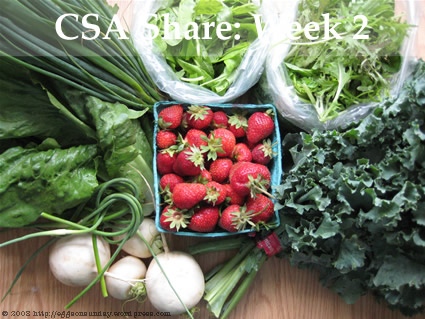
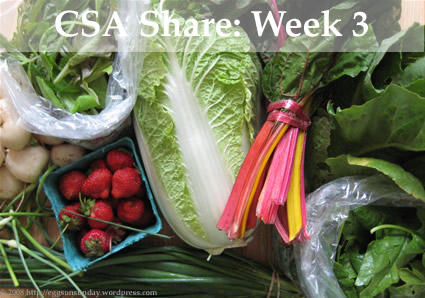
These images are from Eggs on a Sunday.

Friday, October 31, 2008

Plant Some Beans

Okay, finally a follow-up to my last post! What can you do to lessen your fertilizer use? Well, fertilizers mostly provide nitrogen in a form plants can use, and the element nitrogen is an essential compound in living things. Even though the atmosphere is 78% nitrogen gas, plants cannot utilize in that form.


Enter into the picture nitrogen-fixing bacteria! These bacteria are able to transform nitrogen gas into various compounds such as ammonium ions and nitrate, which plants are then able to intake. Well, where can you find these special little critters? It turns out, they like living in the roots of the legume family. Therefore, if you plant lots of beans in your garden along with your veggies, or alternate beans with the other plants, your soil will probably have more nitrogen and you won't need as much fertilizer.

However, beans are great in their own right. So many varieties exist- black, navy, soy, chickpeas, kidney, etc. They are so nutritious - with high protein and fiber, vitamins and minerals. You can definitely find lots of recipes - not just good old baked beans.

Here's a great website, The Gardener's Network, that has a special page about beans.

I was also perusing the Internet for some bean recipes and ideas to show you guys, and here's what I found- The Bean Bible! I never knew there was such a thing. Well, I guess you can find anything online these days.

Here's a great looking black bean burger recipe. Healthy and easy!


The image at the top is from the Latino Nutrition Coalition. What's your favorite bean or bean recipe? Have you ever grown beans?

Sunday, October 26, 2008

Use Less Fertilizer

This post is for all of you that have a nice little vegetable garden but find you need to use lots of fertilizer to keep that little garden going.

What's wrong with fertilizer? Well, a little bit won't hurt anyone, but usually if you use fertilizer, some of it will wash off with the rains. Eventually, all these nutrients from everyone's lawns, gardens, and fields, flow into a large body water. Then a phenomenon called eutrophication occurs. All this excess organic chemicals such as nitrogen and phosphorous causes huge algal blooms to occur.

Definitely not the prettiest sight. Well, this ugly mess does more than just disgust everyone! When the algae die, a lot of dissolved oxygen in the water is used up by bacteria that are decomposing the bloom. And when the level of oxygen is too low, all kinds of marine life can be harmed, including fish. The Chesapeake Bay is the major body of water near where I live, and I know it is going through a major crisis of algal blooms.

So you ask, Molly, what I am supposed to do if I don't want to use that much fertilizer? I can't just let my vegetables and plants die? Don't worry... a post is coming up soon that might be able to help you.

This image is from Plant Management in Florida Waters.

Sunday, October 12, 2008

Don't Waste

Remember how your mother always told you clean your plate, because children elsewhere are starving of hunger? The better strategy, I have learned, is to take less in the first place. This starts way before you serving yourself a meal - back to the grocery store.

Always check for expiration dates and serving sizes. Once I bought a huge bag of flaxseed because it was on sale and I needed a tablespoon of it for a recipe. Well, I forgot one detail- nobody in my family uses flax and nothing else I make requires flax! That sad bag sat on my fridge shelf for three months until it was past the "best used by" date and was tossed into the trash. Really, what a waste of food and money.

Remember how you learned in elementary school that the Native Americans were in tune with nature and respectful of everything, meaning they used the whole animal/plant whenever they killed anything? Well, I'm not suggesting that you demand the bones with your deli meat and carve jewelry, but there are so many things that we throw away without realizing its uses! For example, peels on veggies and fruits can be made into compost, as explained in this previous post.

Another thing many people throw away is the stem of broccoli! That is my favorite part of the vegetable - it's crispy and crunchy when made in a stir-fry. Just peel away the hard outer layer, chop up, and throw into a stir-fry. Most parts of vegetables can be eaten in some form- just today, I learned that the leaves of a pumpkin plant are delicious and nutritious after a quick turn in the pan with some olive oil and salt. Eggshells are good for plants if you crush them around the surface of the dirt.

Some people even eat the shells of shrimp and crabs! I'm definitely not to that step yet- eugh! The point being, a lot of the things people think of as trash and throw away can be used in some way or another. This image is from Innovate Infinitely.

Saturday, September 13, 2008

Create a Compost Pile

Maybe I'm just a little strange, but sometimes I feel bad just throwing out fresh vegetable and fruit scraps into the garbage. I mean, that stuff is natural and decomposable! However, there is no way those bits will break down in a landfill, where it will be pressed down without oxygen and bacteria.

I could get a pig and feed it all my peelings and scraps...but I think I could run into some problems. An easier way to "recycle" your veggie bits and ends is to create a compost pile! If you have a garden, then the compost later can be used as organic fertilizer for your plants. I'm no authority on the ins and outs of composting, so I have compiled a list of sites I have found really helpful below.

How to Compost- this is a extremely comprehensive website for beginners and experts alike. There are lots of general tips, and also some specialized information. For those that love science, the site includes a section about the the scientific details, such as carbon-to-nitrogen ratios.

Tree Hugger
has a fairly basic but straightforward guide to composting.

An interesting site, Journey to Forever, that has articles on composting, as well as "humanure?" I'd say no to the latter part.

If you live an apartment, or have no backyard, visit Mahalo, for a guide on how to compost indoors (without the smell)!

More indoor composting at Tiny Choices.

As you can see, there are various ways to compost, suitable for every lifestyle. Don't limit yourself! This image is from Denver Recycles. It looks so earthy, doesn't it? I wish my soil looked like that.